
Read Rankin County Property Tax Records
A Rankin County tax record pulls together two jobs. The assessor values the parcel, and the collector bills and collects on it. On the parcel card you will find the roll owner, land and improvement values, the assessed amount, a homestead code, the district, and the tax year. Payment status answers a different question than ownership does. So check the displayed year and source first. Only then compare any figures.
| Field | What It Shows | Where |
|---|---|---|
| True or total value | Appraiser's full-value estimate | Tax Assessor |
| Assessed value | Value after the state class ratio | Tax Assessor |
| Homestead code | Relief status shown for the parcel | Tax Assessor |
| Tax bill and status | Amount and paid or unpaid entry | Tax Collector or vendor detail |
| Tax district | Local taxing context | Parcel detail |
Mississippi taxes a share of true value, not all of it. Class I owner-occupied single-family property carries a 10 percent assessment ratio. Most other real property falls under Class II at 15 percent. Multiply assessed value by the millage rate. You get the tax before any relief is applied. Keep perspective on that number. A tax figure is neither a sale price nor an independent appraisal.
Rankin County Tax Search Fields
The Tax Assessor search takes a PPIN, parcel number, name, or street name. The county-linked Delta form adds address and Section/Township/Range. Use whichever key pinpoints one tax account. That way values and payment history stay tied to the right parcel.
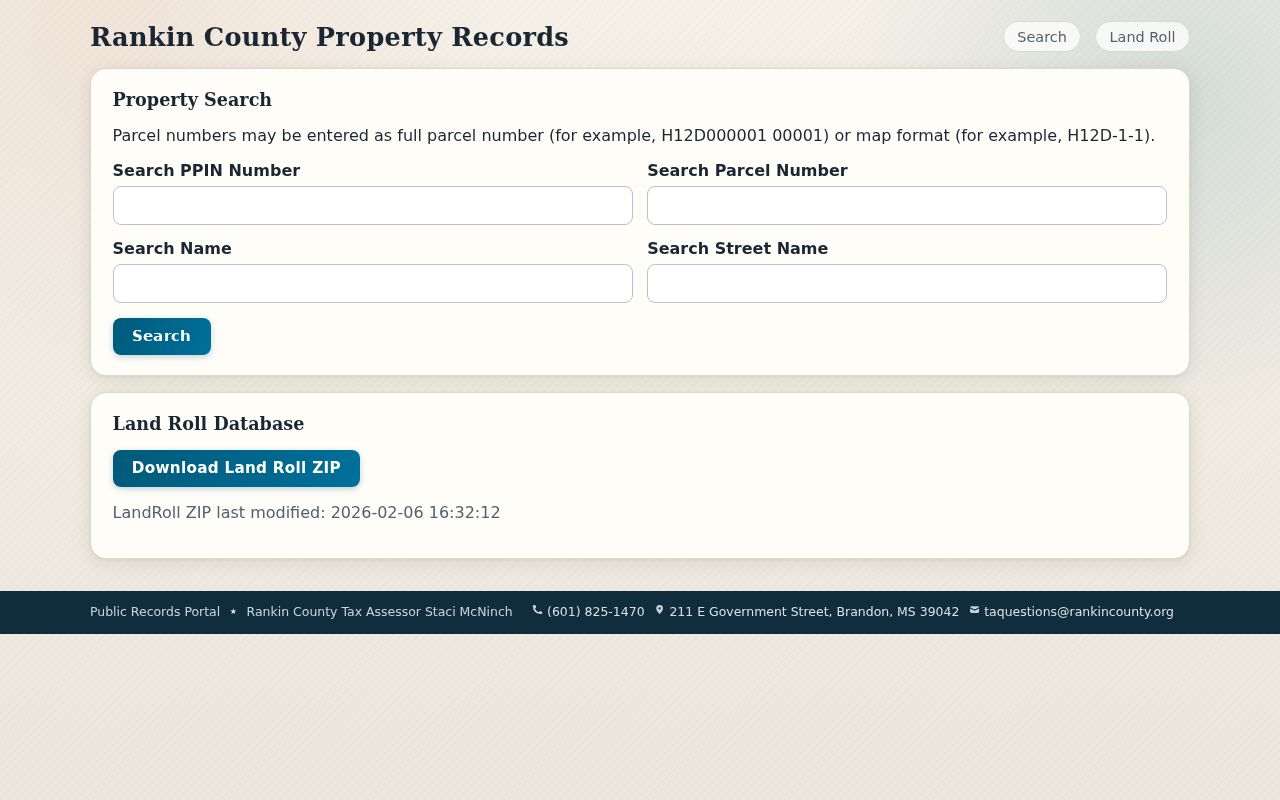
The assessor's search page lays out all four county search routes. When an address-only query pulls too many matches, those alternatives narrow it to a single account.
| Field | What to retain | Why |
|---|---|---|
| OWNER | Exact roll spelling | Shows the assessed-to party |
| PPIN and parcel | Both formats | Connects tax, deed, and GIS |
| Tax year | Displayed year | Prevents stale comparisons |
| Value fields | Land, improvements, total, assessed | Shows the calculation base |
| Book/page | Full reference | Points to the recorded deed |
One sample record shows $195,740 in total value against $19,574 assessed, a clean 10 percent relationship. Confirm the property class and exemption on any parcel before assuming that ratio applies there too.
Rankin County January Roll Rule
Every January 1, Rankin County assesses property tax to the owner of record. That date drives the whole cycle. Bills usually go out near the end of the year. Payment falls due the following February 1 under state guidance. Because of this calendar, deeds can lag. A deed recorded later can name a newer buyer than the assessor's OWNER field still shows. The mismatch is normal, not an error.
Compare Rankin County property tax records against a deed. Check the filing date against the tax year. Never mentally edit one record to match the other. The Chancery Clerk's deed records track when a document was recorded. The tax roll follows an annual assessment cycle tied to that January 1 cutoff.
Rankin County Homestead Timing
County homestead information lists an application window of January 5 through April 1, 2026. It asks for parcel and purchase details along with sensitive identity fields. Work directly with the Tax Assessor. Do not send private data through an informal records request. Other categories include homeowners 65 or older, qualifying disability, and certain disabled veterans. There is also an honorably discharged veteran category for those 90 or older. Proof is required. Verify the current form, year, and eligibility with the assessor.
Rankin County Reappraisal Context
Mississippi law requires every county to revalue real property at least once each four years. The latest Rankin County audit reports the last reappraisal effective October 1, 2021. Treat that as a countywide milestone. It is not the final word. A single parcel can still change between cycles. New construction, corrected characteristics, exemption changes, and board action all shift individual records. When comparing tax values, save both the notice and the roll year.
Dated Rankin County Tax-Sale Lists
The county document center includes a file titled “2022 UNREDEEMED TAXES - AS OF 5/19/25.” Read the as-of date as carefully as any row. Redemption and payment status can change after the list was made. An entry there proves neither current title nor vacancy. Cross-check the parcel and PPIN with the Tax Collector for a live balance. Then turn to Chancery records for the deed or related filing. Keep assessed-to and sold-to names distinct. Each describes a role in the tax-sale record rather than the present owner.
Note: Always record the list's as-of date and verify redemption status with the office before relying on an entry.
Look Up Rankin County Tax Bills
Start with a parcel key, never a payment amount. The Tax Assessor establishes value and roll data. The Tax Collector handles collection and current balances. For balance questions, the collector's Brandon office sits at 211 E Government Street, Suite B. The office phone is 601-825-1467. The county-linked Delta tax and property search pairs the search form with parcel-linked tax results.
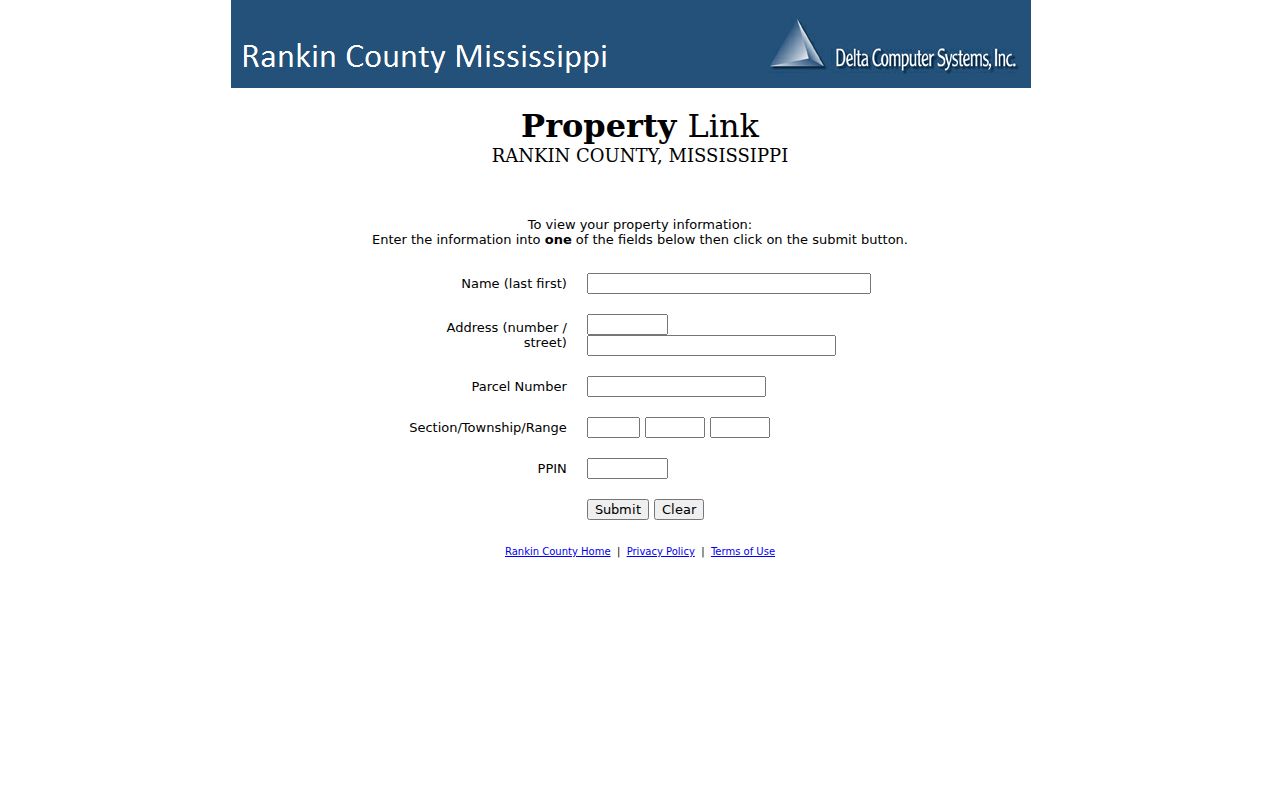
The Delta results view ties each PPIN and parcel to its tax-year entry. Matching those fields first keeps the payment status in the right context.
- Search the assessor or Delta vendor by address, parcel, PPIN, or owner.
- Confirm the tax year, total value, assessed value, and district.
- Read the payment status and last-payment information, then ask the collector for a current balance if needed.
- Check homestead status and any dated delinquent or tax-sale record separately.
- Assessed value
- True value multiplied by the state class ratio.
- Millage
- The rate applied to assessed value to calculate tax.
- Homestead exemption
- Qualifying relief tied to an owner-occupied home.
- Tax lien
- A public claim arising from unpaid property tax.
Calculate Rankin County Property Tax
Mississippi separates true value, assessed value, and tax. True value is the assessor's estimate of full market value. A class ratio then converts that amount to assessed value. Class I applies at 10 percent to owner-occupied single-family residential property. Other real property falls under Class II at 15 percent. Separate classes cover personal property, utilities, and motor vehicles. Confirm the actual classification on the parcel's own record before relying on any ratio.
A sample Rankin detail showed total value of $195,740. Its assessed value was $19,574. That is a clean 10 percent relationship. The pair illustrates the Class I math. It does not prove the class or exemption for another parcel. Read land and improvement values separately. Compare the homestead code, tax district, year, and payment status. A deed's sale price is a different figure. Never substitute it for the assessor's true value.
Millage can combine county, school, city, and special-district components. Mississippi DOR publishes county and city millage data. The current Rankin bill or collector record still controls the property-specific amount. An estimate may differ from the bill. Confirm the class ratio, exemptions, district, and current levy. Do not assume an arithmetic error.
Access Rankin Tax Records Offline
Online property tax records are only one channel. The Tax Assessor at 211 E Government Street in Brandon maintains the appraisal and roll information. Staff there can explain parcel characteristics, ownership updates, homestead coding, and value entries. The Tax Collector sits in Suite B of the same government complex. That office handles collection, current balances, and payment questions. Its directory also lists Flowood and Richland locations. Match the office to the question.
The assessor page links a downloadable land-roll ZIP. Its metadata updates with each release. Note the file name and schema with any analysis. For a missing record or a large export, a written Mississippi Public Records Act request can identify the PPIN, parcel, roll year, specific fields, and preferred format. Ask for a fee estimate. Electronic or GIS retrieval may be billed at actual cost.
Audit a Rankin County Tax Entry
A sound audit starts with identity. Confirm the street, PPIN, full parcel number, legal description, and tax district before touching any money fields. Then record the tax year and owner. Note the land value, improvement value, total value, and assessed value. Add the homestead code and payment status. Note the last-payment date too. A mismatch at the identity stage can make every later calculation look plausible. The whole audit may then point at the wrong tract.
Owner names need a date label. Mississippi assesses property to the January 1 owner of record. The roll can lag a deed recorded during that same year. Use the assessor name for tax-roll questions and the latest verified grantee for conveyance questions. An appeal, exemption, or payment may turn on current ownership. Ask the responsible office which proof it requires.
Value fields also need labels. Land value covers the site component and improvement value covers taxable improvements shown in the appraisal record. Total value combines both components. Assessed value applies the relevant class ratio. Homestead relief can change the tax outcome. The code on a public detail does not disclose every fact used in an application.
Payment status moves faster than a saved screenshot or dated list. A sample Delta detail showed a tax-year record. County and school taxes were marked paid. A last-payment date was included. Those fields show what data exists. They do not give the current status of every parcel. For a payoff, redemption, or pending sale, contact the Tax Collector. Request a current figure tied to the correct PPIN.
Tax-sale research adds more roles. A county list can identify the assessed-to party, sold-to party, PPIN, parcel, Section/Township/Range, prior deed, date, and balance. Treat neither name as a current ownership finding. Redemption, later deeds, and Chancery filings may change the outcome after the list's as-of date.
Keep the tax packet compact. Include the assessor detail and a bill or collector confirmation. Add an exemption or appeal notice if relevant. Add a dated tax-sale entry if relevant. The deed reference should only reconcile ownership timing. That division keeps a tax account from being mistaken for a title report.
Contest a Rankin County Assessment
Mississippi DOR guidance places assessment objections before the Board of Supervisors. The normal deadline is the first Monday in August preceding the tax due date. Confirm the current Rankin County calendar. Don't treat the general rule as your own deadline. Bring the notice, parcel number, class, exemption status, and property characteristics. Also bring any sale or appraisal evidence.
Start with the assessor. Ask for an explanation of the land, improvement, class, and exemption entries. Preserve any response or correction. An appeal challenges the assessment. It does not replace a deed dispute, boundary survey, or payment inquiry.
Appeal window. State guidance normally points to the first Monday in August. Verify the current deadline and filing method with Rankin County before acting.