
Trace Rankin County Former Owners
Start with the newest recorded deed. Skip any loose surname search. The assessor record supplies the PPIN, parcel, legal description, and deed book and page, and the Chancery index turns each earlier transfer into one clean row of the timeline.
| Transfer point | Grantor to grantee | Recorded form | Book/page trail |
|---|---|---|---|
| Newest deed | Immediate former owner to current grantee | Read exact deed type | Start with assessor citation |
| Earlier deed | Previous owner to immediate former owner | Verify estate conveyed | Follow acquiring deed |
| Older deed | Earlier grantor to previous grantee | Keep liens separate | Match legal description |
The grantor on the newest deed is the name to hunt as a grantee in earlier years. Match the subdivision, lot, and Section, Township, and Range. Watch related instruments too. A deed of trust only secures a debt, so it never earns a row as a former owner.
Decode Rankin's Prior-Owner Chain
A grantor conveys an interest. A grantee receives it. The chain of title links those transfers. A reverse index is built from the grantor side, while the grantee side shows how a person acquired the same land. Warranty and quitclaim deeds carry different promises, so record the exact type with each step.
- Grantor
- The party conveying the stated interest.
- Grantee
- The party receiving that interest.
- Chain of title
- The linked history of recorded transfers.
- Quitclaim deed
- A transfer of whatever interest the grantor may have, without warranty-deed promises.
- Book/page
- The volume and page used to retrieve an image.
Related instruments can flag corrections, releases, or older deeds. Read them, but keep the timeline to filings that actually convey the tract you are tracing.
Reconstruct Rankin Deeds Backward
The Official Records Inquiry searches names, dates, instrument types, parcel ID, legal description, subdivision, address, PPIN, and book and page. Start with one deed and a narrow time span.
- Open the current deed and record grantor, grantee, file date, deed type, land description, and book/page.
- Search its grantor as a grantee in earlier years, using parcel and subdivision terms to remove namesakes.
- Open that acquiring deed and confirm the same land.
- Repeat until the web trail ends, then carry the last book/page to scanned volumes or microfilm.
- Reverse search
- Following each grantor back to an earlier acquiring deed.
- Legal description
- The land wording that survives address changes.
- Prior deed
- The instrument by which a later grantor had acquired the property.
Initials, estates, trusts, and corporate names break clean chains. Search both party roles. Inspect probate or fiduciary instruments when the acquiring deed is missing, and never bridge a gap just because two people share a surname.
Rankin's Online Ownership Cutoff
The Land Title Association of Mississippi reports Rankin land records online from roughly the 1950s to the present. Treat that as a broad guide. It guarantees nothing for every series or image. If a web result differs, the county says its in-office Official Records Index controls.
The web trail has a limit. Former owners before the approximate 1950s coverage may require the Virtual Index, deed books, and MDAH microfilm.
Save the last solid book and page. It becomes the bridge when you switch systems, keeping the offline search tied to the same property.
Open Rankin Historic Deed Images
The Virtual Index offers record-type, book, and page selectors for scanned official records. Print and purchase controls sit on screen. Confirm any charges before ordering.
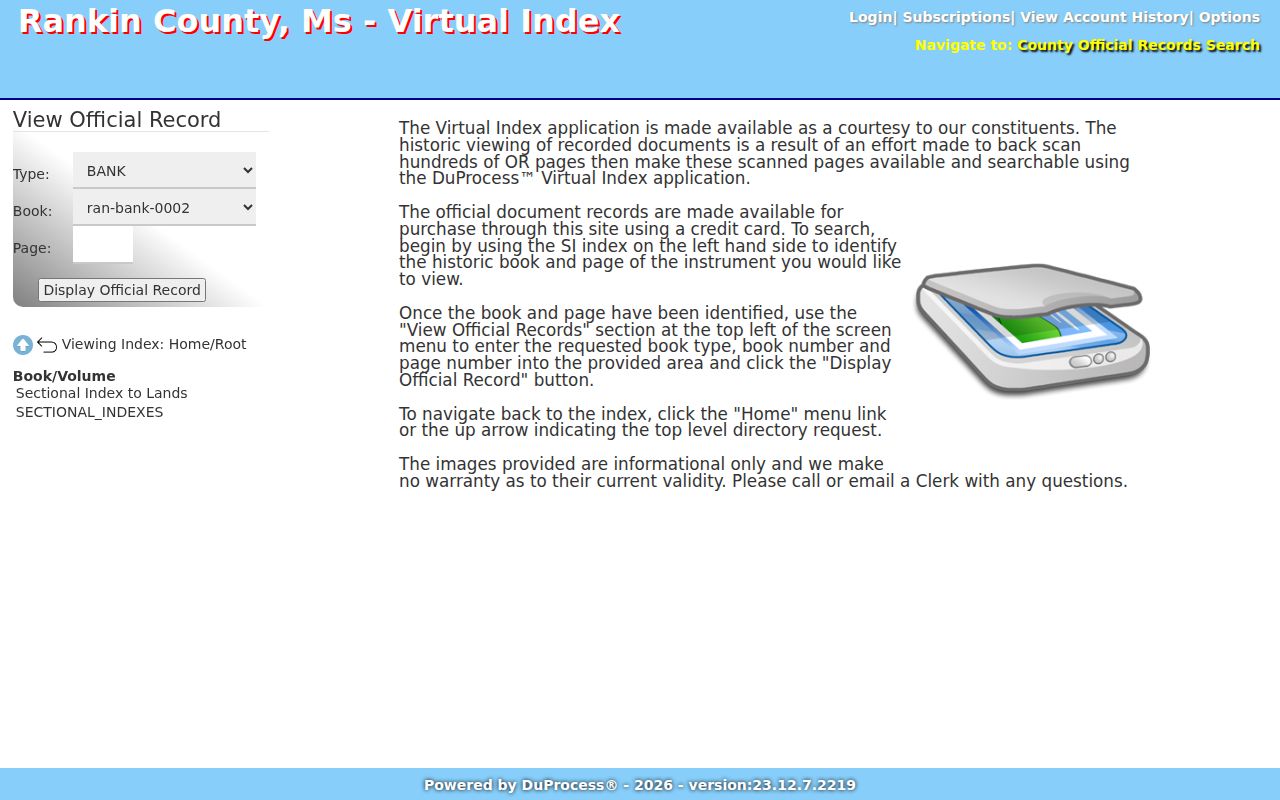
Use the selectors once a deed, office index, or archive note supplies the right series. Pick the right book too. Oil and Gas Books from 1974 through 2003 hide a local quirk. Append 011 to the public book number. Mineral instruments belong to a distinct series. They can matter to title. So keep them out of an ordinary surface-deed chain unless evidence says otherwise.
Rankin Owners Before Online Records
The Mississippi Department of Archives and History describes Rankin records spanning 1819 through 1940. The formats include originals and microfilm. Tax-roll material covers 1818 through 1902. The courthouse microfilm catalog adds a Rankin filter and a media-room route.
A tax-roll name places a prior owner in a year. It does not replace the deed. Pair the name with section, township, range, old road, plat, and map-grid clues. Then confirm the candidate in a deed volume.
Rankin's Susie Blue Book
Susie Blue Buchanan was a deputy Chancery Clerk. She served from 1924 to 1938. She compiled a local plat reference known as the Susie Blue Book. The MDAH finding aid says it was still in use in 1988. That long working life shows something valuable. A local index can bridge old subdivision descriptions with later records.
A plat maps lots, blocks, streets, and easements. It can confirm that successive deeds concern the same mapped lot. It does not name every former owner. Pair it with deed parties and dates to finish the chain.
Bridge Rankin Estate Transfers
A death can interrupt a simple seller-to-buyer chain. Search Chancery probate files, wills admitted to probate, court orders, survivorship terms, and later fiduciary deeds. Restricted death certificates are no routine public shortcut.
For inherited land, gather the assessor card, latest and prior deeds, probate reference, tax status, GIS or plat, and any instrument vesting an heir or buyer. That packet shows the gap. It does not invent a transfer.
State Rankin Owner History Carefully
A deed image with matching land text beats a tax-roll name, a modern parcel candidate, or a surname index entry. Label each source and date. State plainly any volume, year, or record series left unsearched.
Lawful use. Research prior owners for house history, estate work, and purchase diligence. Never use the trail to track, harass, or harm a living person.
A do-it-yourself timeline is not a complete title abstract. It cannot promise that every easement, mineral interest, lien, probate event, or correction surfaced. A legal transaction calls for a title professional's search of the controlling records.